
Studio notes
AI Market Analysis: Real Help or Empty Promise?
Where does AI genuinely help with market analysis, and where is it an empty promise? Real uses, regulator warnings, red flags and five simple questions.
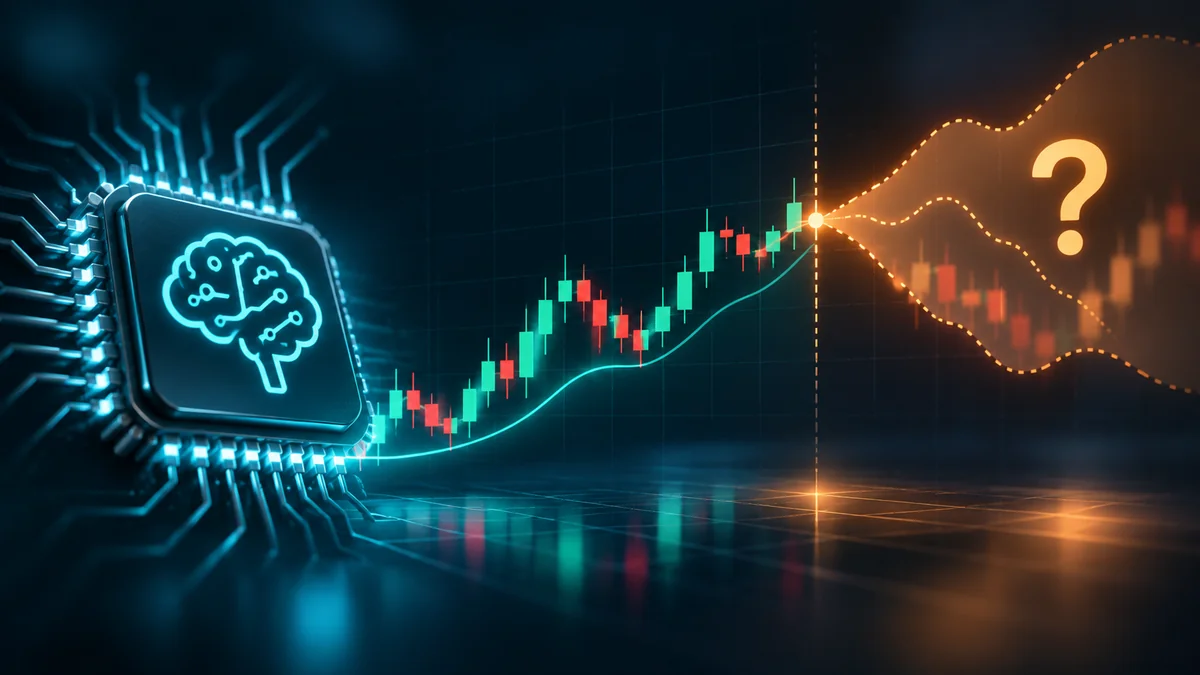
These days it is hard to find an ad about gold, crypto or stocks that doesn't mention artificial intelligence. One sells "smart analysis", another "AI-generated signals", and a third claims its algorithm already knows where prices are heading. Meanwhile, plenty of people quietly ask a chatbot to summarize the day's economic news or explain a term they don't understand.
Both get called "AI market analysis", yet they are worlds apart. This article is not buy or sell advice, and it promises no profits. The aim is simple: to look, in plain language, at where AI genuinely helps someone who follows the markets, where the claims ring hollow, and how to tell the two apart.
First, what are we actually talking about?
In this context, AI means software that learns patterns from large amounts of data instead of just following a fixed list of instructions. In the markets, it usually shows up doing three quite different jobs, and it helps not to mix them up:
- Reading and summarizing text: tools such as chatbots that read a news story, a report or a central bank statement and tell you what it says in plain words.
- Organizing and watching numbers: software that keeps an eye on prices and data and alerts you when a condition you set is met, or that sorts through your trading history.
- Prediction: the claim that the software knows whether the price will be higher or lower tomorrow or next week.
The first two sound modest, but that is where most of the real help lies. The third is the loudest, and it is where most of the empty promises come from.
Where AI genuinely earns its keep
People who follow markets seriously are rarely short of fortune-tellers. What they are short of is time and focus, and that is where AI helps most:
- Summarizing news and reports: instead of reading dozens of articles and statements, you get a short summary of what changed, with a pointer to the original source. The decision is still yours, but the time you used to spend hunting for news goes into thinking.
- Watching the market for you: software can monitor several markets at once and only tap you on the shoulder when something you care about happens, such as a sudden price jump or an important announcement. You don't have to stare at charts all day.
- A tidier trading journal: if you keep a record of your trades, a smart tool can point out patterns you might miss, for example that most of your losses come after a run of back-to-back trades, or at a particular time of day.
- Making sense of jargon: for a newcomer, being able to ask "what is core inflation?" and get a plain answer is a real help, as long as the answer is checked against a reliable source.
What these uses share is that AI takes the tedious, time-consuming work off your plate while a person still makes the call. It doesn't make the decision for you.
Where the promise turns hollow
Trouble starts when we ask a tool to do something nobody, human or machine, can do reliably: know the future.
The US Commodity Futures Trading Commission (CFTC), which oversees futures markets there, says plainly in a customer advisory that this technology cannot predict the future or sudden market changes. Markets are shaped by millions of people, unexpected news and political and economic decisions. A pattern that worked yesterday may not work tomorrow.
There is another catch. A joint investor alert from the US Securities and Exchange Commission (SEC), the North American Securities Administrators Association (NASAA) and FINRA, the US broker-dealer self-regulator, points out that AI-generated information can rest on data that is inaccurate, incomplete or outdated, and can even draw on false information spread on purpose to move a price. Even when the input is accurate, the alert says, the output can be faulty or completely made up. Chatbots sometimes state, in a perfectly confident tone, a figure that exists nowhere.
The same alert makes a subtler point: depending on how answers are presented, conversations with chatbots can nudge people towards emotional or impulsive decisions. A fluent, confident answer feels more trustworthy than it deserves.
And remember: good results in the past are not a promise about the future. An impressive profit chart built on historical data may only show that the software memorized the past well. We go into this trap in more detail in our article "What Is a Trading Bot, and Does It Really Make Money?" on the Behvandi website.
When "AI" is just a label
Sometimes the problem isn't that the AI gets things wrong. Sometimes there is no AI at all. In March 2024, the SEC settled charges against two investment advisers over false and misleading statements about their use of AI, with $400,000 in total penalties. According to the SEC, the firms told clients they were using AI in certain ways when in fact they were not. The SEC's chair at the time called this "AI washing": slapping an AI label on a product that lacks the capability, simply to make it look more attractive.
Those were registered, supervised firms. Now imagine how freely the same label gets used in channels and pages that nobody supervises at all.
Across the Atlantic, the European Securities and Markets Authority (ESMA), in a statement to investment firms, acknowledged the potential benefits of AI while listing risks such as poor data quality, opaque decision-making and "overreliance" on AI by both firms and their clients. In other words, regulators see the value, but they treat leaning on it entirely as a risk in itself.
Red flags worth taking seriously
If a tool, a channel or a person makes you an offer in the name of AI, treat these as warning signs:
- Guaranteed or "risk-free" profits: the joint SEC and FINRA alert quotes exactly this kind of line: "Our proprietary AI trading system can't lose!" or "Use AI to Pick Guaranteed Stock Winners!" In real markets there is no such thing as a guaranteed return without risk.
- Unbelievable percentages: the CFTC mentions claims of returns in the tens of thousands of percent, or "100 percent win rates".
- Pressure and urgency: "today only", "limited spots", "before it's too late".
- Borrowed credibility: celebrities, influencers, or videos that may themselves be AI fakes. The joint alert explains that fraudsters use this technology to clone voices and create fake videos.
- Rewards for bringing in friends: when a large share of the promised income comes from recruiting new people rather than from trading itself.
To see how real the danger is: in the same advisory, the CFTC describes a case in which one man took more than $1.7 billion in bitcoin from at least 23,000 people over about three years. His pitch was a trading bot that guaranteed at least a 10 percent monthly return. According to the CFTC, very little money was actually traded, and the scheme ran as a Ponzi scheme, paying earlier investors with newcomers' money. You'll find a fuller list of these tricks in our article "How to Spot Crypto Scams and Fake Signal Sellers".
Five questions before you trust any AI analysis
You don't need a technical background to size up a tool or an analysis. A few simple questions go a long way:
- Where does its data come from, and how fresh is it? Analysis that won't say what it is based on, or that relies on months-old data, is no use for today's decision.
- Can it show its sources? A good summary puts the original story or report next to each claim so you can check it yourself.
- Does it admit its limits? An honest tool tells you where it isn't sure. One that speaks about everything in the same confident tone is a cause for concern.
- Who stands behind it? Is there a named company or person you can actually reach? Official alerts recommend checking the background and registration of whoever is offering it, and getting a second opinion before handing over money.
- What are the hidden costs? The CFTC reminds people that fees, spreads (the gap between buying and selling prices) and subscription costs all eat into returns and need to be counted.
A hypothetical example: two ways to use the same idea
Imagine two people who both want to follow the gold market.
The first asks a smart tool every morning to summarize the important economic news from overnight, with links to the sources. If something looks significant, she reads the original. She has also set an alert in case the price moves more than a limit she chose in a single day. Whether to buy or wait is her call, made with money she could afford to lose.
The second sees an ad in a channel for "high-accuracy AI signals", buys a subscription, and follows every message without question, because "the AI said so".
Their tools might carry the same label. The first has turned AI into an assistant. The second has handed his decisions to a black box he knows nothing about.
A short note on risk
Every trade carries risk, and you may lose some or all of the money you put in. No tool, smart or otherwise, removes that risk. This article is educational and is not a recommendation to buy or sell any asset. Only put in money whose loss would not upset your life, and for important decisions, talk to a licensed, independent adviser.
What does a good AI tool look like?
Whether you are an individual or a business offering financial services to your own clients, a good AI tool for market work usually has a few things in common: it shows the source behind what it says, its data is current and traceable, everything it does is logged so it can be reviewed later, and it leaves the final decision to a person.
At Behvandi Studio, this is the kind of tool we build: for example, an assistant that summarizes news and reports about a market with the sources attached, a system that watches several markets and alerts you only under conditions you define, or a tool that organizes your trading journal and highlights recurring patterns. If you're thinking about a trading bot, our articles "Seven Things to Settle Before You Build or Buy a Trading Bot" and, for MetaTrader users, "AI in MetaTrader 5: From Market Analysis to Trading Bots" are good places to start.
The bottom line
AI in market analysis is neither a miracle nor useless. Ask it to tell the future and it will let you down sooner or later; and if someone sells guaranteed profits in its name, you are most likely looking at marketing hype or a scam. But ask it to free up your time, organize scattered information and point out what you might have missed, and it becomes a genuinely useful assistant.
If you have an idea for a tool like this, or you'd like to know what is realistic for your situation and what isn't, we'd be glad to hear from you through the "Contact us" page on the Behvandi website, even if the conclusion turns out to be that you don't need a new tool just yet.
Sources
- CFTC — Customer Advisory on trading bots marketed with AI claims: the technology cannot predict the future, and the Mirror Trading International case
- SEC, NASAA and FINRA — Artificial Intelligence (AI) and Investment Fraud: joint alert on AI-themed fraud, deepfakes, and not relying solely on AI-generated information
- SEC — Press release of March 18, 2024 on charges against two investment advisers for false statements about their use of AI
- ESMA — Statement of May 30, 2024 on AI in investment services and risks such as overreliance
Comments
No comments yet. Be the first to write one.