
Studio notes
What Is a Trading Bot, and Does It Really Make Money? An Honest, Plain-English Guide
Trading bots in plain English: what they do and can't, why guaranteed profit is a red flag, costs and drawdowns, a seller checklist and when a custom bot fits.
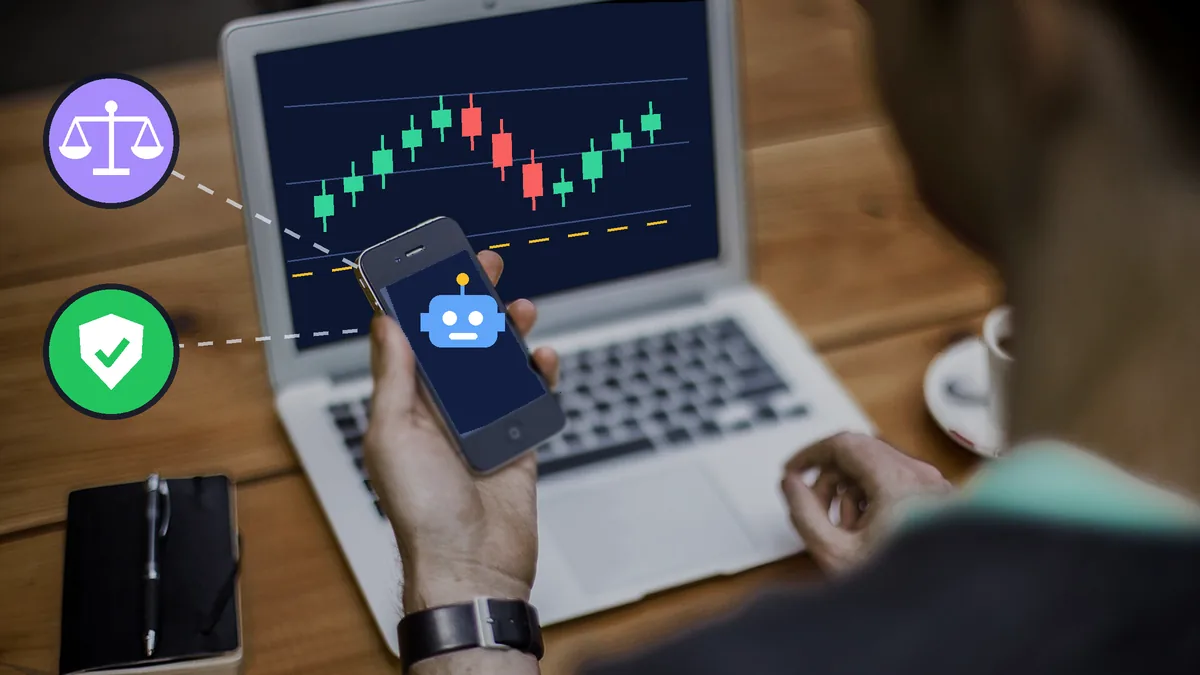
You have probably seen an ad like this one. (It's a made-up example, but plenty of real ones look just like it.) "Our smart bot trades around the clock and delivers a guaranteed 20% a month. Just deposit and relax." Next to it sit a few screenshots of glowing account balances and thank-you messages from happy users.
Tempting, isn't it? Money that works by itself while you watch the profits roll in. But what is really behind a promise like that? What exactly is a trading bot, and can it actually make you money?
This guide skips the jargon. We'll explain what a trading bot does and what it can't do, why "guaranteed profit" should set off alarm bells, how to size up a bot or the person selling it, and when building a custom bot genuinely makes sense.
A trading bot, in plain terms
A trading bot is a computer program that buys and sells in a market on your behalf: forex, crypto or stocks, for example. The key point is that a bot does not think for itself. It simply carries out instructions it was given in advance.
Think of the thermostat in your home. You tell it: "If the temperature drops below 20°C, turn the heating on; when it reaches 23°C, turn it off." The thermostat never gets tired, never forgets and works at 3 a.m. without complaint. But it has no idea what tomorrow's weather will be, and if you give it the wrong numbers, it will follow them with the same tireless precision.
A trading bot works the same way. It might be told: "If the price rises above this level, buy; if the trade loses this much, sell and get out." The bot follows those rules relentlessly and without emotion. How good the results are depends on how good the rules are, not on how "smart" the bot is.
Common types of bots, without the jargon
Bots come in many shapes. These are the ones you'll run into most often:
- Rule-based bots make decisions from a few set conditions on the price chart; for example, buying when the price climbs above its average of recent days.
- Grid bots place buy orders at regular steps below the current price and sell orders above it, aiming to profit as the price swings back and forth. They can do fine in sideways markets, but if the price falls hard in one direction, they can keep buying all the way down and leave you with a large loss.
- Recurring-buy bots buy a fixed amount at regular intervals, say every week. This is more a savings habit than a way to get rich quickly.
- Copy or signal bots automatically repeat in your account the trades of another trader or a signal channel. Your results depend entirely on the honesty and skill of whoever you're following.
Names and branding change all the time, but every bot has one thing in common: it automatically follows a set of instructions.
What bots are genuinely good at
To be fair, bots have real strengths:
- Discipline. If the rule says "exit at a 2% loss", the bot does it, no hesitation. Many of us struggle exactly here, holding a losing trade and hoping it will come back.
- Speed. A bot checks its conditions and places orders in a fraction of a second.
- Stamina. Crypto markets never close; a bot can keep watch while you sleep.
- No emotions. Fear and greed don't touch it. On a night of dramatic headlines, it does exactly what it did yesterday.
And what they can't do
This is where most ads go quiet:
- A bot can't predict the future. The US Commodity Futures Trading Commission (CFTC), one of America's main market regulators, says so plainly in its customer advisory on trading bots: the technology can't predict the future or sudden market changes.
- A bot doesn't create an edge. If the strategy behind it doesn't make money over time, automating it only helps you lose money faster and more consistently. A bot amplifies a strategy; it doesn't invent profit.
- A bot doesn't understand new conditions. A rule that worked in calm markets can fall apart during a surprise announcement or a sharp crash. Until someone switches it off, the bot keeps doing the same thing.
- A bot doesn't take responsibility. When it loses, it's your money that's gone, not the bot's and not the seller's.
So, do trading bots make money?
The honest answer: sometimes yes, often no, and never guaranteed. A bot is only as good as its strategy, and even good strategies go through losing stretches. A few realities to keep in mind:
1. Costs quietly eat into profits. Every trade costs something: commissions, the spread (the gap between the buying and selling price) and sometimes slippage, when your order fills at a slightly worse price than the one you saw on screen. Bots that trade often pay these small costs over and over, and then there's the bot's own subscription fee. A strategy that makes, say, 2% on paper can end up at zero or below once all that is subtracted. The CFTC's advisory makes the same point: consider the impact that fees, spreads and subscription costs would have on returns.
2. Losing periods are unavoidable. Even profitable strategies can lose for weeks or months in a row. The largest fall from an account's peak to its low point is called the drawdown. The important question isn't just how much a bot has made; it's how much it lost in its worst stretch, and whether you could live with that.
3. A simulated past isn't the future. Most sellers show you a backtest, meaning the bot run on historical prices. Backtests are useful, but they're built with the benefit of hindsight. US rules take this seriously enough that under the CFTC's regulations (17 CFR 4.41), commodity trading advisors and pool operators covered by the rule must place a specific warning right next to any simulated or hypothetical performance they present. In short, it says the results don't represent actual trading; because the trades weren't really executed, they may under- or over-state the effect of factors such as lack of liquidity; they were designed with hindsight; and there's no claim that any account will achieve similar profits or losses. If you want to know why bots that shine in backtests stumble in live accounts, read our article "Why live trading bots fail after a perfect backtest" in the Behvandi articles section.
4. Most retail traders in leveraged markets lose money. In 2018 the European Securities and Markets Authority (ESMA) said that analyses by national regulators across the EU showed that 74–89% of retail accounts typically lose money trading CFDs, a leveraged product widely offered by forex brokers. That figure covers all retail traders, manual and automated alike, but it makes one thing clear: markets are not a place for easy money, and a bot doesn't change that. Leverage magnifies gains and losses alike, and a highly leveraged bot can empty an account very quickly.
In short, a bot can be a useful tool for running a tested strategy. It is not a money machine.
Why "guaranteed profit" bots are either marketing or a scam
Nobody can guarantee profits in financial markets. If a bot truly produced certain profits every month, its owner would have no reason to rent it to you for a monthly fee.
The CFTC warns that fraudsters use automated trading algorithms, signal strategies and crypto schemes to promise unreasonably high or guaranteed returns. It also flags claims of returns in the tens of thousands of percent or "100% win rates". A familiar trick is a dashboard full of profits while your money is never really traded and only a number on the screen goes up, until the day you try to withdraw. In one case the CFTC cites in that same advisory, customers' impressive balances were created on demo accounts and new investors' money was used to pay earlier ones.
Warning signs to watch for:
- a fixed monthly return or "no risk" promise;
- pressure to send money to an account or wallet the seller controls, rather than keeping it in your own account with a reputable broker or exchange;
- urgency: "limited spots" or "tonight only";
- bonuses for bringing in friends and family;
- testimonials and screenshots you can't verify.
The US Securities and Exchange Commission (SEC) also warns that fraudsters on social media impersonate trusted people and rely on fake testimonials, paid actors and influencers. We cover these tricks in more detail in our guide "How to Spot Crypto Scams and Fake Signal Sellers: A Plain-English Guide for Everyone".
A simple checklist for judging a bot or its seller
Before you buy, rent or hand money to any bot, ask:
- Where does the money sit? Ideally it stays in your own account with a reputable broker or exchange, and the bot can trade but not withdraw.
- Is there a real track record, or only a backtest? Ask for several months of live, verifiable trading that includes the losses, not just the best months.
- What was the worst drawdown? If the seller can't or won't answer, be careful.
- Are the costs clear? Add up commissions, spreads, subscription and any profit share, and see what's left of the claimed return.
- Do they explain the logic? They don't need to reveal trade secrets, but they should be able to say in plain words when the bot tends to work and when it loses. "Secret advanced AI" is not an explanation.
- Can you try it on a demo account or with a small amount first? A trustworthy seller welcomes testing.
- Who is the seller? Look up the people and their history. The CFTC suggests running a reverse image search on key people and checking how long the website's domain has been registered. If they claim a licence, check it on the regulator's own website, not through a link they give you.
- Get a second opinion. Before depositing, talk it over with someone knowledgeable and independent.
And one golden rule: only put money into any kind of trading that you could lose without it upending your life. To work out the most you could lose before each trade, see our article "Risk Management and Position Sizing: Know What You Can Lose Before You Enter a Trade".
When does a custom bot make sense?
For all these caveats, bots aren't bad tools; they just need to be used for the right job. A custom bot usually makes sense when:
- you already have a strategy with clear rules that you've traded by hand for a while, but you struggle to follow it consistently;
- you want repetitive tasks automated, such as placing stop-losses, closing trades at a set time or watching several markets at once;
- you need strict risk controls, like automatically stopping for the day after a set loss;
- you want to test your idea fairly before risking real money.
But if you don't have a strategy yet and hope a bot will find one for you, building a bot isn't step one. Step one is building and testing the strategy itself.
At Behvandi, this is how we design, build and test trading bots. We start by writing your strategy's rules down precisely, with no ambiguity. Then we test it on historical data with costs included, run it on a demo account for a while, and only then move to a live account with a small amount. Risk controls are part of the design from day one, not a patch added at the end. We don't promise profits, because no one can. Our job is to make sure the bot does exactly what it's supposed to, and that you know what you're facing in the worst case.
The bottom line
A trading bot is neither a saviour nor a villain. It's a tool that follows instructions consistently, quickly and without emotion. With a sound strategy and controlled risk, it can genuinely help. Without them, it just speeds up the losses. And whenever someone promises guaranteed profits, the best move is to keep your money in your own pocket.
If you have a strategy and want to know whether turning it into a bot makes sense, or you're looking for someone to build a bot with serious risk controls and test it honestly, we'd be glad to hear from you through the "Contact us" page on the Behvandi website.
This article is for educational purposes only and is not financial or investment advice. Trading in financial markets, especially with leverage, can result in the loss of some or all of your capital.
Sources
- CFTC — customer advisory on trading bots and promised returns
- US Code of Federal Regulations, 17 CFR 4.41 — required statement for simulated or hypothetical performance
- ESMA — press release of 27 March 2018 on CFD measures and retail loss rates (PDF)
- SEC / Investor.gov — Social Media and Investment Fraud investor alert
Comments
No comments yet. Be the first to write one.